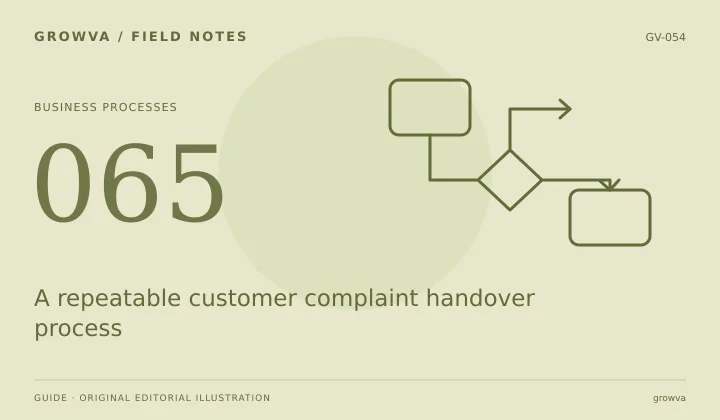
A complaint handover process should allow a second person to understand the issue without asking the customer to repeat the whole story. It also needs to preserve what the business has promised and who can decide the response. A clear record supports consistent handling without presuming that every complaint has the same cause or remedy.
Create one case record
Record the date received, customer contact route, relevant job or order, the issue in the customer’s terms, requested outcome, supporting evidence and current owner. Separate the reported issue from the business’s assessment. “Customer reports staining after service” is more precise than an unverified conclusion about who caused it.
Write an acknowledgement step that tells the customer who is handling the matter and when they can expect the next update. Set realistic internal targets and have the responsible owner approve them; do not copy deadlines from an unrelated industry.
Define decision authority
Make clear which staff can gather information, offer operational options or authorise a remedy. A person receiving the complaint should know how to escalate uncertainty. The procedure must not use a standard script to rule out rights that may apply under consumer law.
In a hypothetical cleaning business, a customer reports a missed area after a team leaves. The office opens one case linked to the original job, captures the customer’s photographs with permission and assigns a supervisor. When a different staff member receives a follow-up call, the case shows the promised update time and who is reviewing the work.
Hand over the next action explicitly
Every open case should have an action, owner and next review date. Record the reason for any proposed outcome and the authority that approved it. Keep the customer response separate from internal notes so staff do not inadvertently share speculation or unrelated personal information.
When the issue is resolved, record the agreed outcome and any follow-up. A closed case may still produce an improvement action, such as clarifying a booking question or changing a completion checklist. Link that action rather than repeatedly reopening the customer case for internal administration.
Australian Government and ACCC guidance provide useful starting points for complaint handling and resolving problems. Check the requirements relevant to the business and obtain advice where rights or remedies are unclear. The workflow above organises communication and accountability; it does not determine a customer’s legal entitlement.