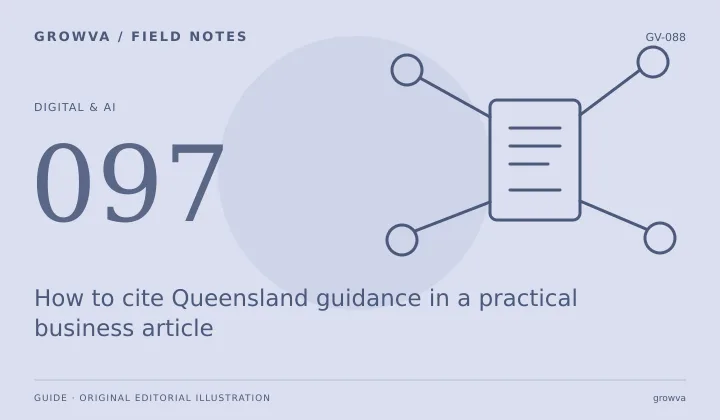
A useful business article lets readers distinguish official guidance from the writer’s own recommendations. A source link at the bottom is not enough if the text makes it unclear which organisation said what, which jurisdiction applies or whether a suggestion is mandatory. Build the citation into the writing process.
Create a claim ledger before drafting
For each external factual statement, record the exact source page, issuing organisation, page title, date checked and the sentence or section supporting the claim. Add a field for scope: Queensland, Australia-wide, a particular contract form or one sector. If the source does not support the proposed wording, change the wording rather than stretching the citation.
Keep an explicit distinction between a source’s position and your suggested workflow. For example, Business Queensland’s operational-document guidance can be linked as background, while a proposed weekly register review should be described as Growva’s practical suggestion. Do not imply that the government requires that exact meeting frequency unless a current applicable rule actually says so.
Put the reference beside the claim
Name the organisation and link to the specific page rather than its homepage. Use short paraphrases and avoid copying long passages. If quoting is necessary, keep it brief and exact. Do not let an automatically generated reference or a search-result snippet substitute for reading the underlying page.
A hypothetical article about tender preparation might draw on an official tender guide, while its sample folder structure is the author’s own example. Label the example so a reader does not mistake it for an agency’s required submission structure. The live tender instructions remain the relevant source for that opportunity.
Maintain the reference after publication
Record an editorial owner and a meaningful review date. Recheck time-sensitive statements, form names, portal routes and external links when the article is reviewed. If a source moves, confirm the replacement covers the same subject. If it no longer supports a claim, revise or remove that claim and record the change.
A disclaimer cannot repair an unsupported statement. Avoid universal wording such as “all contractors must” when the source discusses one context. Good citation makes the article easier to challenge, update and trust. It also keeps original advice visible as advice, so readers can decide whether it suits their own business or project.