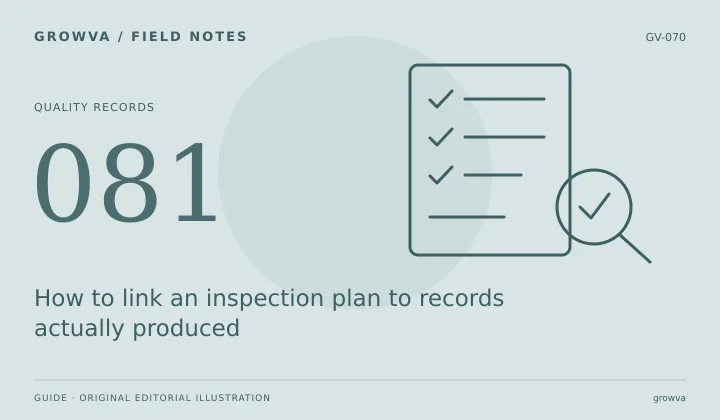
An inspection plan describes checks expected during the work; a record register shows what evidence can be located afterwards. Connecting the two requires identifiers that remain meaningful from planning through delivery and closeout.
Start with the approved activity list
Use the current project inspection or verification plan as the source. Record the plan reference and revision, activity identifier, work package, location or lot, required record type and responsible role. Ask the authorised project owner to confirm any unclear activity or acceptance requirement.
Create a separate occurrence for repeated checks where the project requires them. One plan activity might apply to several work areas, batches or installation stages. A single tick against the activity can conceal incomplete coverage if the work is repeated.
Link completed evidence without altering it
For each occurrence, record the source file, record number, date, location or asset identifier and review status. Keep the original signed record intact. If a filename lacks a useful identifier, add the cross-reference in the register and ask the issuer to resolve any ambiguity.
Treat missing evidence, incomplete evidence and evidence awaiting review as different states. An available file is not automatically an accepted record. The reviewer specified by the project decides whether the record satisfies the relevant requirement.
Worked example
In a hypothetical civil package, an inspection-plan activity applies to three defined work lots. The register has three occurrence rows, each linked to its own location and record reference. Two records are received; the third remains requested with an owner and due date.
The summary therefore shows two of three occurrence records received, while retaining the separate review statuses. It does not show the entire activity as complete merely because one signed form is present.
Reconcile both directions
Check from the plan to the records: does every required occurrence have a traceable status? Then check from the records to the plan: can each supplied record be assigned to the intended activity and work scope? Investigate unmatched files and duplicate identifiers rather than forcing a match.
Agree the frequency of reconciliation with the package owner. This is a clerical traceability method, not an inspection service or technical acceptance process. Project-specific instructions, approved changes and the authorised review route control what evidence is required and how it is accepted.