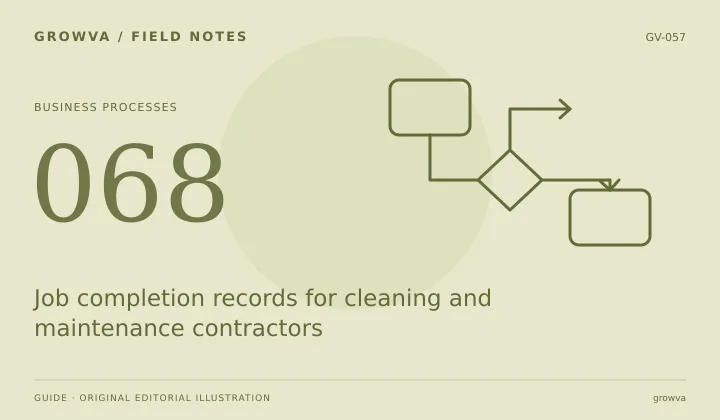
A useful job-completion record tells the next person what was done, what was not done and what needs attention. For cleaning and maintenance contractors, it should reflect the customer-agreed task list rather than an expansive generic checklist. A page full of ticks is weak communication if an important exception is hidden in a message elsewhere.
Start with the agreed service
Link the completion record to the job number, service location, scope version, appointment date and team. Identify the tasks that require confirmation and the evidence expected by the customer. Keep technical assessments or regulated work records with the authorised person’s instructions and documentation.
Use a small set of outcome labels, such as completed, not completed, not applicable with reason, or follow-up required. Do not let “not applicable” become a convenient substitute for explaining why an agreed task was omitted.
Make exceptions the centre of the handover
For every unfinished or changed item, capture the location, issue, reason, customer contact if made, next action and responsible owner. Where photographs help, retain an original-file reference and collect or share images in line with the business’s privacy arrangements.
In a hypothetical commercial-cleaning visit, the team cannot enter one storeroom because access is unavailable. The completion record identifies the room, records the access issue and names the office person arranging the next step. The job is not labelled simply “complete” because the accessible areas were cleaned.
Keep acknowledgement precise
If the customer acknowledges the visit, record what that acknowledgement represents. A signature or message confirming attendance should not be presented as technical acceptance, agreement to extra charges or a waiver of rights. Use the business’s approved wording and seek advice on contractual meaning when necessary.
Before the team leaves the workflow, make sure the office can find the completion record and any follow-up action. A daily review of unresolved exceptions is often more useful than checking whether every worker uploaded the same number of photographs.
Business Queensland’s guidance supports procedures that staff can understand and use. Apply that principle by testing the form on an ordinary visit and an exception-heavy visit. Remove fields that are never used for a decision, and add missing context that repeatedly triggers calls back to the field team. The record should support service delivery, customer communication and learning without creating unnecessary administration.